We compared manufacturer specs, manuals and warranty terms. We have not hands-on tested these products yet. How we research
We may earn a commission when you buy through links on this page. As an Amazon Associate I earn from qualifying purchases. How we make money
A portable power station runs phones, lights, a fan or a small appliance without burning fuel. The decisions that matter are capacity in watt-hours, continuous output in watts, the outlets you need and whether it takes solar. This page is for car campers who want power at the site.
We compared 4 portable power stations and picked 4.
Our picks at a glance
1
Best overallJackery Explorer 1000 v2A 1,024 Wh LiFePO4 battery with 1,500 W output, enough for a CPAP, lights and a fridge over a long weekend.
Currently unavailable on Amazon
2
Best for fast chargingEcoFlow Delta 3A 1,024 Wh station with 1,800 W output and fast AC recharging, for short stops between campsites.
Currently unavailable on Amazon
3
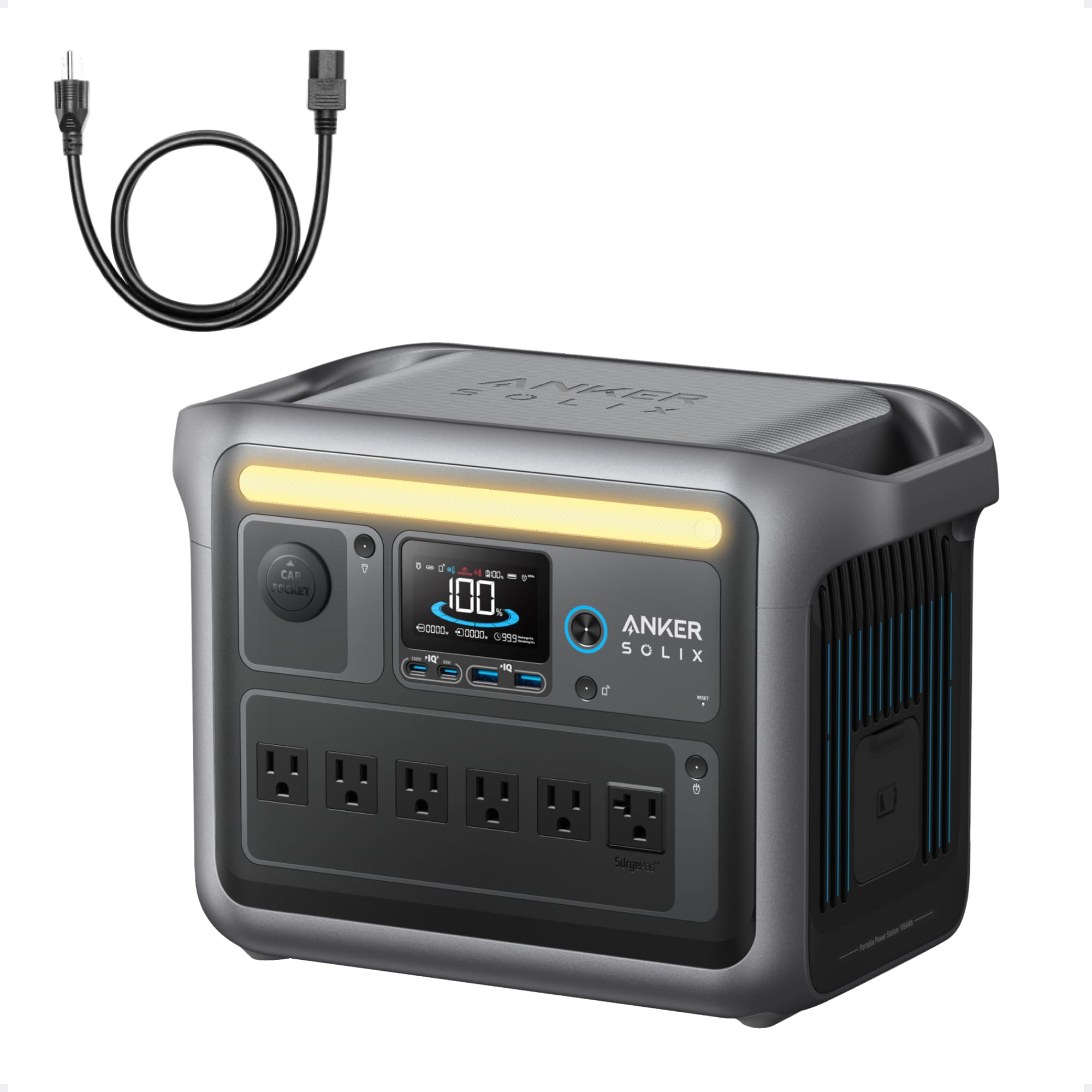
Best for high-draw gearAnker SOLIX C1000About 1 kWh of LiFePO4 storage and 1,800 W output for kettles, hair dryers and power tools.
Currently unavailable on Amazon
4
Best capacity for the moneyBLUETTI AC1801,152 Wh and 1,800 W in a LiFePO4 unit, the most storage here for the price.
capacity sets how long the station can run your devices.
Continuous output
the output in watts decides which devices the station can run at once.
Outlet mix
AC, USB-C PD and 12V outlets decide what plugs in without adapters.
Solar input and recharge time
solar input lets you recharge at camp, but only if the station lists it.
Weight
a large capacity makes a heavy box, so check the weight before you carry it.
Battery chemistry and cycle rating
chemistry affects lifespan and weight, and cycle ratings are maker claims.
We compared 4 portable power stations that fit this page and picked 4.
Sources: manufacturer product pages, manuals and warranty terms, plus CDC guidance on carbon monoxide and generators.
Specs as listed: every value in our table comes from the manufacturer or seller listing. Cycle ratings and recharge times are maker-stated. A dash means the listing does not give that spec.
We have not hands-on tested these products. Full method
The best portable power stations
1. Best overall: Jackery Explorer 1000 v2
Best overall
Why we picked it
A 1,024 Wh LiFePO4 battery with 1,500 W output, enough for a CPAP, lights and a fridge over a long weekend.
Pros
LiFePO4 battery
1,500 W output
Cons
About 24 lb
Key specs
Continuous output (W)
1500 watts
Weight (lb)
23.4 pounds
Currently unavailable on Amazon
2. Best for fast charging: EcoFlow Delta 3
Best for fast charging
Why we picked it
A 1,024 Wh station with 1,800 W output and fast AC recharging, for short stops between campsites.
Pros
1,800 W output
Fast AC recharge
Cons
Heavier than mid-size units
Key specs
Continuous output (W)
1024 watt-hours
Weight (lb)
12.5 kg
Currently unavailable on Amazon
3. Best for high-draw gear: Anker SOLIX C1000
Best for high-draw gear
Why we picked it
About 1 kWh of LiFePO4 storage and 1,800 W output for kettles, hair dryers and power tools.
Pros
1,800 W output
LiFePO4 battery
Cons
Heavy
Key specs
Continuous output (W)
1800 watts
Weight (lb)
27.6 pounds
Currently unavailable on Amazon
4. Best capacity for the money: BLUETTI AC180
Best capacity for the money
Why we picked it
1,152 Wh and 1,800 W in a LiFePO4 unit, the most storage here for the price.
Pros
1,152 Wh capacity
1,800 W output
Cons
Bulkier than newer designs
Key specs
Capacity (Wh)
1152 milliamp_hours
Weight (lb)
37.4 pounds
Currently unavailable on Amazon
How to choose the right portable power station
Start by adding up what you want to run, then check capacity, output and outlets. If you are weighing it against a gas generator, read our carbon monoxide guide first.
Capacity in watt-hours
Capacity in Wh is the energy stored. Add up the devices you want to run and divide the station's usable Wh by their watts for a rough runtime. Expect less than the label says, because of conversion losses. Our lantern guide shows lower-power options. Make a short list of the devices you would run, such as phones, lights and a fan, and note the watts printed on each label before you compare capacities.
Continuous output
Continuous output is the most the station can supply steadily; surge is a short peak for starting motors. Check the listing against the watts on your devices' labels, and leave some margin. If two devices run together, add their watts, and check the surge figure for anything with a motor.
Outlet mix
Look for AC outlets for household plugs, USB-C PD for phones and laptops and a 12V port for car-style accessories. A station with plenty of capacity but the wrong outlets is no use. Count the number of AC outlets against the devices you plan to plug in at once, and check the USB-C PD wattage if you want to charge a laptop.
Solar input and recharge time
Check the maximum solar wattage the maker allows, and whether a solar panel is included or sold separately. Recharge times are maker-stated and depend on sun and panels. If you rarely camp in open sun, a station that recharges from a car or wall outlet before the trip may suit you better than one that depends on a panel.
Weight
Capacity and weight rise together. For car camping the trunk does the lifting, but you still have to move it. Check the Weight column and the handles. Look for handles that are easy to grip, since you will lift it in and out of the car.
Battery chemistry and cycle rating
Different battery chemistries age differently. Maker-stated cycle ratings show how many full charges the maker expects. Treat them as marketing, and compare warranties. Look at the warranty length, which tells you how long the maker stands behind the battery, and read what it excludes.
Tips for using your portable power station
Add up your devices' watts before you shop, and leave headroom on the continuous output.
Follow the maker's manual for ventilation, temperature and water exposure, and keep the station dry.
Charge the station fully at home before you leave, and check the maker's manual for how to store it between trips.
CDC says to run a generator outdoors only, more than 20 feet from windows, doors and vents, and never inside, even with windows open (CDC).
CDC lists small engines among the sources of carbon monoxide (CDC), which is one reason battery power suits a camp where people sleep in tents.
FAQ
Is a power station safer than a gas generator in camp?
A generator burns fuel, so it makes carbon monoxide; CDC says it belongs outdoors, more than 20 feet from windows, doors and vents, never inside. A battery station burns no fuel at all (CDC).
How long will it run my device?
Divide the station's usable watt-hours by the watts the device draws. Expect a shorter time than the math gives, because the label figure is not the whole story.
Can I charge it with solar?
Only models that list a solar input can. Check the maximum solar wattage the maker allows.
Can I use it in my tent?
The maker's manual is your guide: it covers ventilation, operating temperature and keeping the unit away from water before it goes in a tent.
Capacity, insulation, wheels and weight for camping coolers, with food-safety rules.
Pine & Pitch
The Weekend Camping Checklist
Ten Essentials packed: map, sun protection, extra layer, headlamp and spare batteries, first aid, fire, repair kit, extra food, water treatment and emergency shelter.
Sleeping bag chosen by its ISO Comfort rating, not its Extreme rating.
Sleeping pad R-value checked (ASTM F3340).
Cooler thermometer reads 40°F or below, and drinks ride in a separate cooler.
pine-and-pitch.com
Get the Weekend Camping Checklist
A printable checklist covering the NPS Ten Essentials, the ratings to check on your sleep gear, safe cooler temperatures and the fire and carbon monoxide rules. No charge, and sized to hang on the fridge.